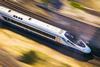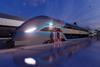



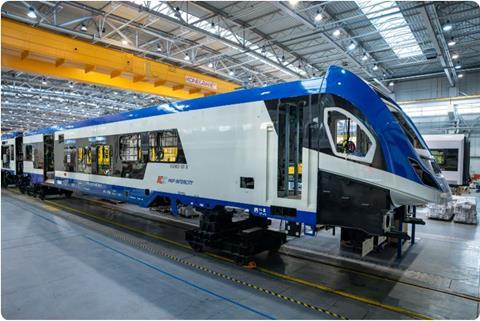
POLAND: Delegations from the Ministry of Infrastructure and national operator PKP Intercity visited the Nowy Sącz factory of Newag on February 18 to see the production of the first of 35 electro-diesel long-distance trainsets.
The vehicles are being produced by Newag for PKP Intercity under a May 2024, 3·36bn złoty agreement that includes 10 years of maintenance, to be carried out with the involvement of the operator’s employees.
Bistro, quiet zone, staff compartment
The articulated trainsets will have a capacity of 179 passengers seated (156 in standard class and 21 in first class), and two designated spaces for passengers with disabilities.
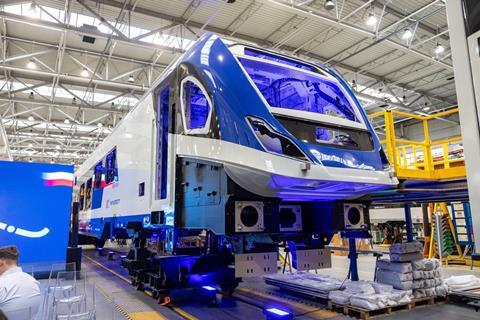
They are designed to operate at speeds of up to 160 km/h on electrified lines and up to 120 km/h on routes without wiring. The Euro Stage V-compliant diesel engines will have an operating range of up to 920 km between refuelling.
The trains will feature an ETCS onboard unit, air conditioning, ergonomic seats, power sockets, USB-A and USB-C ports at the seats, and individual seat lighting. They are also to be equipped with bicycle storage, as well as a family zone with tables and a game board for children and spaces for luggage. They are also to have a bistro and food vending machines, a quiet zone in both classes, as well as a compartment for the onboard staff.
New routes, faster journeys
The first vehicle is to be delivered in early 2027, and all are to arrive by mid-2029.
PKP Intercity plans to deploy the bi-mode vehicles to add capacity on existing long-distance services running on partially electrified routes, in some cases doubling, or even quadrupling the existing service offering. Bi-mode operation will also shorten travel times as the need to change locomotives en route would be avoided.
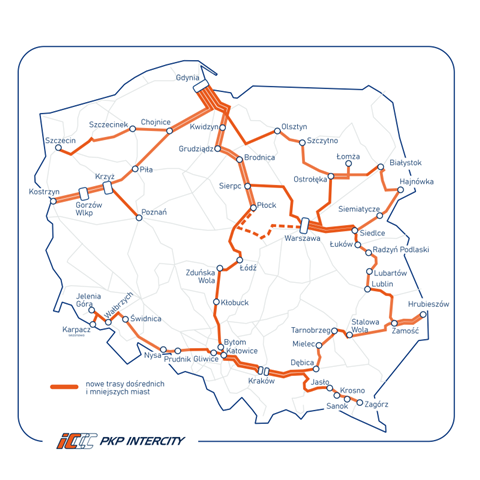
The operator is also planning to launch a number of new through services, restoring connections after a hiatus of more than 40 years in some cases. The trains will serve a total of 70 localities across the country, PKP Intercity reports.
They are to be deployed on the following routes:
- Gdynia – Tczew – Chojnice – Szczecinek – Szczecin;
- Gdynia – Tczew – Chojnice – Piła – Krzyż – Gorzów Wielkopolski - Kostrzyn;
- Gdynia – Tczew – Iława – Olsztyn – Szczytno – Ostrołęka – Białystok – Hajnówka – Siemiatycze – Siedlce – Warszawa (new route);
- Gdynia – Tczew – Kwidzyn – Grudziądz – Brodnica – Sierpc – Plonsk – Warszawa;
- Poznań – Krzyż – Gorzów Wielkopolski – Kostrzyn;
- Kraków – Tarnów – Jasło – Krosno – Sanok – Zagórz (a route currently operated by leased DMUs);
- Kraków – Katowice – Gliwice – Prudnik – Nysa – Świdnica – Wałbrzych – Jelenia Góra (– Karpacz in holiday seasons, on a recently reopened line);
- Hrubieszów – Zamość – Stalowa Wola – Tarnobrzeg – Mielec – Dębica – Kraków;
- Warszawa – Siedlce – Łuków – Radzyń Podlaski – Lubartów – Lublin – Zamość – Hrubieszów;
- Gdynia – Sztum – Grudziądz – Rypin – Płock – Gostynin – Łódź – Kłobuck – Bytom – Katowice – Kraków;
- Warszawa – Ostrołęka – Łomża (once the Ostrołęka – Łomża line has been reopened to traffic).